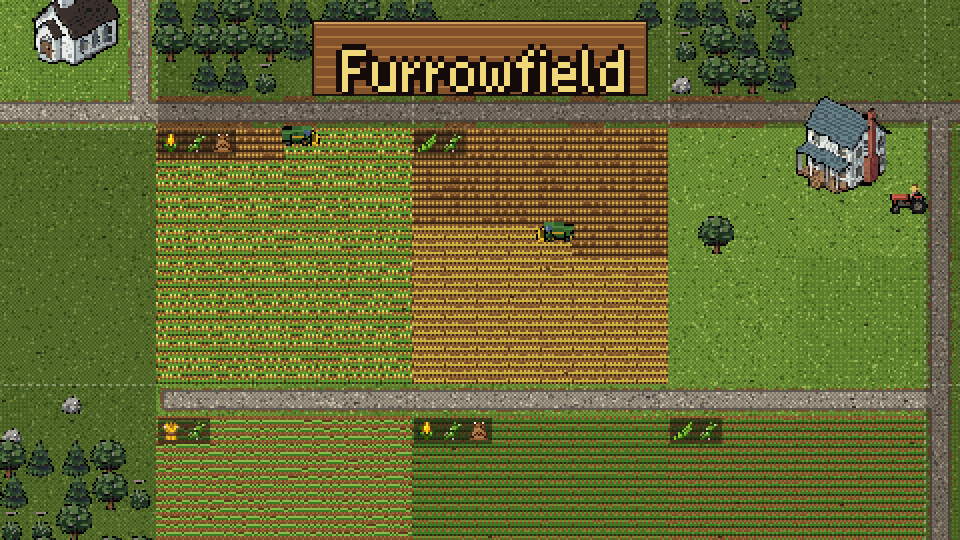
Furrowfield is a free browser farm management sim with crop rotations, irrigation, machinery, and changing prices. Each of its four farms has a goal and a deadline. Plan what to plant, keep fields healthy, and leave enough cash for the bills that arrive between harvests.
Key Takeaways
- Furrowfield is a SimFarm-style farm sim played on a little pixel art desktop, with a menu bar, a weather strip and windows for the bank and the market.
- Every field keeps its own crop rotation, plus gauges for water, nutrients, pests and toxins.
- Tractors, combines and trucks really drive the map, plowing, harvesting and hauling the crop to your silos or the grain elevator in town.
- Four farms each have a goal and a deadline, from paying off a mortgage on the prairie to raising a herd of 20 cows in the highlands.
- Weather, crop prices and the bank all push back, so planning beats clicking fast.
A SimFarm-style farm sim on a pixel art desktop
The screen looks like a little windowed desktop from the early 90s. A menu bar and a row of icon buttons sit along the top, next to a weather strip, the date and your funds. The farm itself lies in the Edit window, with a tool palette down the side. Click an icon and a window opens for buying machines, selling crops, checking the market, the bank or your evaluation.
Once you assign field rotations and jobs, machines carry out the work. Your attention shifts to water, soil condition, available equipment, and cash flow. Watch those systems together: a large planting plan is only useful if the farm can afford to harvest it.
Fields, crop rotations and healthy soil
Fields are 8 by 8 tiles, and each one keeps its own crop rotation, for example corn, then soybeans, then a fallow year, repeated. Every crop can only be planted in its season, so a field planned for corn waits until spring.
Each field also has gauges that tell its story:
- Water, from dry to flooded.
- Nutrients, which crops like corn, potatoes and cotton drain, and soybeans and alfalfa put back.
- Pests, which build up when the same crop grows year after year.
- Toxins, which pesticide leaves behind when it kills those pests.
Rotating crops is the heart of good farming. A fallow year lets pests die out and toxins fade, and a soybean or alfalfa year restores the soil for free. Fertilizer and pesticide work faster, but they cost money and the soil pays for it later.
Water, ditches and valves
Irrigation depends on connected water routes. You can pump water from the river, drill a well anywhere, build a windmill or tap a creek, and then dig ditches to carry it to your fields. Water flows along connected ditches and through open valves.
Valves let you choose which fields get water and which get drained. When a dry spell hits, open them and irrigate. When the rain won't stop, shut them so the ditches beyond run dry and the soaked fields can drain. On the river bend farm, with its rice and floods, this is the difference between a good year and a ruined one.
Machines that really drive the map
Tractors drive out to plow, plant, fertilize, and spray. Combines harvest, while trucks take crops to silos or the town's grain elevator. Jobs go to the nearest available machine, and gravel roads help it reach the field faster.
Machines wear out, last longer under a shed roof and can be repaired or sold. If you don't own a machine of the right kind, one is leased from town for a fee per job. That works fine on day one, but the fees add up, so compare purchase costs with the jobs you expect before buying equipment.
Weather, prices and the bank
Frost, drought, floods, hail, and locusts can affect a season. Check the forecast and current field warnings rather than assuming a full week of advance notice. Crop prices move with the seasons and with sudden booms and busts. Prices are lowest right after harvest, so storing grain in your silos and selling in late winter often pays better than selling straight from the field.
The bank lends against your land, takes interest and part of the loan every twelve weeks, and collects taxes at the end of each year. Run out of cash and credit and the farm is lost.
Four farms, four different challenges
The campaign has four farms, each with a goal and a deadline:
- A prairie homestead. Pay off a $20,000 mortgage within two years.
- A wet river bend. Meet the briefing's net-worth target while managing rice paddies and seasonal floods.
- A dry valley. Keep the soil healthy with orchards and windmills where water is scarce.
- A cold highland farm. Raise a herd of 20 cows, with fenced pastures, haystacks, water troughs and a barn for the winter.
When the Evaluation window says the goal is met, you can finish the farm for a time bonus or keep farming for a higher net worth.
How to start your first farm
- Read the goal in the briefing.
- Pick the New field tool and click on your own land. Land for sale is shaded and has to be bought first.
- In the field's window, click the rotation slots to choose crops and tick Repeat.
- Let your tractor do the plowing and planting. When a crop is ripe, the field queues a harvest.
- Watch the warning icons in each field's corner. The Field window explains in plain words what each field needs.
On a phone, hold it upright: the farm fills the screen with the tools in a bar below. Tap a tool and then the farm, and use the Hand tool to drag the view.
Frequently Asked Questions
Is Furrowfield like SimFarm?
Yes, it follows the same idea as the classic farm sims of the early 90s: a windowed screen, fields with crop rotations, ditches and valves, machines that drive the map, weather and a crop market. Each farm has its own goal and deadline.
Is Furrowfield free to play?
Yes. Furrowfield is free in your browser with no download. Sign in for supported leaderboard results and achievements. Check the game's save and continue options before leaving an unfinished farm.
How do I water my fields?
Build a pump next to a river or pond, a well anywhere on your land, or a windmill, and dig a ditch from it to your fields. A field that touches a wet ditch is irrigated. Shut a valve to dry out the ditch beyond it.
Should I buy machines or lease them?
Leasing costs a fee for every job and adds up quickly. Once you farm several fields, compare the purchase cost of a combine or truck with the repeated lease fees. A machine shed keeps them out of the weather so they last longer.
How do cows work?
Cows appear on the last farm. They need a fenced pasture with a haystack and a water trough, and a barn when it freezes. They give milk money every week and have calves when they are healthy and have room.
Plant your first season
Furrowfield is a free farm management sim for patient planners: design the rotations, get the water right and let the machines do the work. If you enjoy farming games, also try Harvest Hollow, our cozy six-day farming game, or build upward in Liftwell.