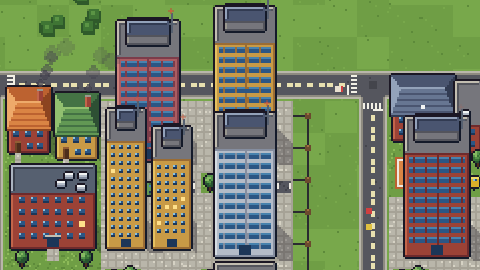
Pixelopolis is a city builder in pixel art that you play right in your browser, in the spirit of the classic city sims of the late eighties. You are the mayor of an empty valley in January 1900, and you have a 20-year term to grow it from a muddy crossroads into a metropolis with a metro, a stadium and an airport.
Key Takeaways
- Pixelopolis is a classic city building game: you zone land as residential, commercial, industrial or office space, and the city builds itself where demand, power and roads allow it.
- Run the whole city: power plants and lines, water pumps and pipes, roads, highways, roundabouts, rail, buses and a metro with its own underground view.
- Every January you set taxes and fund roads, police and fire. Two years in debt or two years of approval under 20% and the council recalls you.
- Your score is the population weighted by approval, plus a point for every $50 left in the treasury, on a shared leaderboard.
- Plays on desktop and phones, in English, Spanish and German, and your city saves itself so you can come back to it.
A city building game where the city builds itself
You never place a single house in Pixelopolis. You paint zones, and the citizens decide what to build. A residential zone fills with cottages, then terraced houses, then apartment blocks and finally a residential tower. Shops grow from a corner store to a skyscraper, industry from a workshop to a chemical plant, and offices from a little pavilion to a glass tower with a helipad on the roof.
What makes a zone grow is the same puzzle that made the old city sims so gripping. Every zone needs power, a road along one side and demand for its kind. Four bars at the top of the screen, R, C, I and O, tell you what the city wants right now. Homes want jobs and shops nearby. Shops want customers. Industry wants workers. Offices want educated residents and clean land of good value.
Get the mix right and the map starts to breathe: houses pop up along the new street, cars head off to the factories, and the population counter climbs every month. Get it wrong and you see lightning bolts over unpowered blocks, empty lots and a line of complaints in the mayor's evaluation.
Power, water and the city under the streets
Pixelopolis gives you the full set of networks a growing town depends on.
- Power. Coal and wind plants at first, then hydro, oil, gas, nuclear and solar, feed the grid through power lines, and power also flows from building to building. Each grid only has the megawatts of its own plants, so a booming district can brown out while the rest of town is fine.
- Water. Past low density, zones need water. Pumps pull it from the ground, and a pump on a shore pumps half as much again. Pipes carry it under roads and buildings to the zones.
- Traffic. Every home sends its workers to real jobs, along real roads. The busiest streets jam up and fill with smog, so highways and roundabouts are worth their price.
Pick the pipe or metro tool and the map flips to an underground view: dark soil, your pipes, and the tunnels you have dug. It is one of the most satisfying moments in the game to switch back and forth and see the whole city working on two levels.
Trains, buses and a metro to clear the roads
Once the streets fill up, public transport is how you keep the city moving.
Trains stop at train stations that sit by the rails and touch a road. Join two districts with a railway, put a station at each end, and the commuters ride instead of driving. You can watch the blue trains run along the tracks.
Buses come from a bus depot. A depot takes up to 40% of the commuters from homes within 10 tiles on its own streets and puts them on buses, which take far less room on the road than all of their cars.
The metro opens in 1906. Build stations by the streets, join them with tunnels, and every trip that rides the metro leaves room on the roads above. Switch to the metro view and you can watch the red trains run through your tunnels. Click any station with the Query tool and it tells you how many people got on or off there last month.
Parks that change with the seasons
Parks are more than decoration. Every park tile raises land value and cuts pollution around it, which is how you coax a neighbourhood of small houses into growing taller.
When you plant a park you choose its look: trees, a fountain, flower beds, a pond, a playground or one big tree, or let each spot pick its own. You can give an existing park a new look later without tearing anything down. Paths join neighbouring park tiles and run out to the street.
The parks live through the year with your city. Fresh saplings grow into young trees and then into full crowns over two years. In spring the trees blossom, in autumn they turn orange and red, and in winter the branches go bare, the flower beds rest, the fountains are switched off and the ponds freeze over.
Taxes, disasters and keeping the voters happy
Every January the taxes come in and the bills go out. Open the budget to set the tax rate and the funding for transport, police and fire. Low taxes help the city grow, high taxes fill the treasury, and cutting the road budget slowly lets the streets crumble.
Then there is everything a mayor cannot plan for. Fires break out where no fire station reaches. Crime rises where no police station covers the streets. Every few decades a tornado tears a path through town. As the city grows, residents start to ask for a stadium, commerce for an airport and industry for a seaport, and growth stalls until you deliver.
The evaluation window shows how many citizens approve of you and what bothers them most, from traffic and pollution to taxes and housing. Lay any of the map overlays over the city (power, water, traffic, pollution, crime, land value, police, fire or population) to see exactly where the trouble is.
How to start your first city
- Start with power. Put a coal plant near the middle of the land, away from where people will live, because it pollutes.
- Lay a road next to it and zone a few residential and industrial blocks along the road. Run a power line from the plant to your first zones.
- Press play and watch the R, C and I bars. Add commercial zones once people live in town.
- Build a water pump and lay pipes under the zones before they need to grow past low density.
- Keep homes away from industry, and plant parks near them to raise land value.
- Add police, fire and schools as the town grows, and public transport once the roads start to jam.
Every map comes from a number, so the same number always gives you the same river, lake or coastline. The map of the day is the same for every player, which makes it a fair race on the leaderboard.
More building games on PixelDen
If you enjoy watching something grow under your hands, PixelDen has a few more sims to try. Stack a highrise floor by floor in Liftwell, the tower building sim, run a family farm against the weather in Furrowfield, or build a kingdom from a hand of cards in Cardholm. You can read more about the tower sim in our Liftwell launch post, or browse the whole game catalog.
FAQ
Is Pixelopolis free to play?
Yes. Pixelopolis runs in your browser on PixelDen with nothing to install. You can play as a guest, and signing in lets your score go on the leaderboard under your name.
Is Pixelopolis like the original SimCity?
It follows the rules of the classic 1989 city sim: zones that grow on their own, power plants and lines, road and rail, demand bars, police and fire coverage, a yearly budget, disasters and a mayor's evaluation. It adds office zones, water pipes, buses and a metro, and the map, art and rules are its own.
Why won't my zones grow?
A zone needs power, a road next to it and demand for its kind, and past low density it also needs water. Pick the Query tool and click the zone: it tells you whether it lacks power, a road, water, jobs, workers or customers, and how land value, pollution and crime pull on it.
Can I play Pixelopolis on my phone?
Yes. On a phone the toolbar moves to the bottom of the screen in portrait. Tap a tool and tap or drag on the map, use the hand tool to move around and pinch to zoom.
How long does a game of Pixelopolis take?
Your term lasts 20 in-game years. At the slowest speed that is about 13 minutes of running time, but you can pause whenever you like to plan, so most terms take longer. After the term you can keep building in free play, and the city saves itself so you can finish it another day.
How is the score counted?
At the end of your term the population is multiplied by 0.5 plus your approval share, so a big city that likes its mayor scores best, and every $50 left in the treasury adds a point.
Build your first city today
Pixelopolis brings the classic city building game back to life in pixel art: zone the land, run the power and water, dig a metro, plant parks that change with the seasons and keep the voters on your side for 20 years. Pick a map, press play and start building Pixelopolis now.